
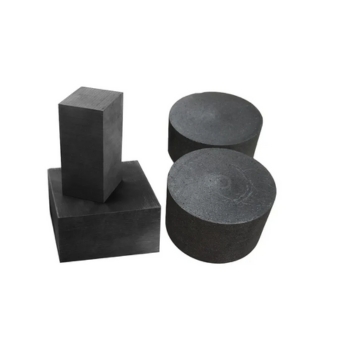
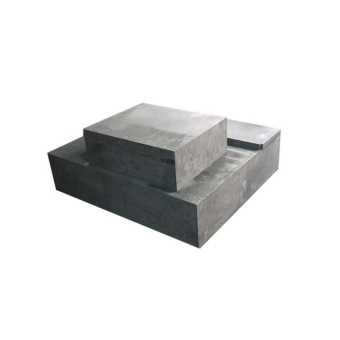
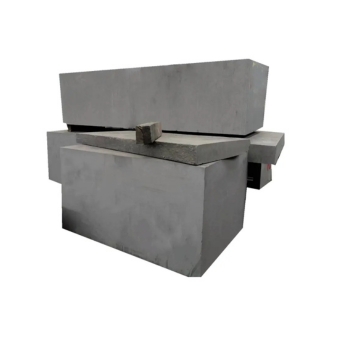
Isostatic graphite block

Product Description
An isostatic graphite block is produced by applying equal pressure from all directions to fine graphite powder during forming. This isostatic pressing method eliminates directional weaknesses and results in an exceptionally homogeneous internal structure. After molding, the material undergoes high-temperature baking and graphitization, ensuring superior crystallinity and stability.
Compared with molded or extruded graphite, isostatic graphite exhibits near-isotropic properties, meaning its strength, density, and conductivity remain consistent regardless of orientation. This characteristic is critical in precision applications where even minor material variation can affect performance or yield.
Core Material Properties
Ultra-Uniform Density and Structure
Isostatic graphite blocks typically feature densities ranging from 1.75 to over 1.90 g/cm³, depending on grade. The fine and evenly distributed grain structure—often below 10 μm—contributes to excellent mechanical integrity and dimensional stability. In practice, this uniformity supports tight machining tolerances and repeatable performance across batches.
From a materials standpoint, this is one of the main reasons isostatic graphite commands a higher position in the graphite hierarchy.
High Temperature Capability
Isostatic graphite blocks maintain structural stability at temperatures exceeding 3,000°C in inert or vacuum environments. Low thermal expansion and strong resistance to thermal shock allow the material to perform reliably in rapid heating and cooling cycles. For high-temperature furnaces and crystal growth systems, this reliability is not optional—it is essential.
Mechanical Strength and Wear Resistance
Due to its fine grain and isotropic structure, isostatic graphite demonstrates higher flexural and compressive strength than conventional graphite grades. It also shows improved wear resistance, making it suitable for long-term service in mechanically demanding environments.
Actually, many users notice that components made from isostatic graphite simply last longer under the same operating conditions.
Electrical and Thermal Conductivity
Isostatic graphite blocks offer stable and predictable electrical conductivity, which is crucial for applications such as semiconductor heating elements, electrodes, and current-carrying components. Thermal conductivity is also consistent in all directions, enabling uniform heat distribution and minimizing localized thermal stress.
Chemical Purity
High-purity isostatic graphite blocks can achieve extremely low ash content, often below 50 ppm, with specialty grades reaching even lower impurity levels. This makes them suitable for sensitive processes in semiconductor manufacturing, photovoltaic production, and advanced materials research.
Machining and Processing Advantages
Despite its high strength, isostatic graphite remains highly machinable. It can be precisely processed using CNC milling, turning, drilling, and grinding techniques. The material supports complex geometries, thin-wall designs, and fine surface finishes without excessive tool wear.
Dimensional accuracy is one of its standout advantages. For users working with micron-level tolerances, isostatic graphite block provides confidence that machined parts will meet design intent without unpredictable deformation. As always, effective dust extraction is recommended during machining due to the fine graphite particles generated.
Major Application Areas
Semiconductor and Electronics Industry
Isostatic graphite blocks are extensively used in:
Single crystal growth furnaces
Wafer processing equipment
Heating elements and susceptors
Their purity, thermal stability, and isotropy help maintain process consistency and reduce contamination risks.
Photovoltaic and Crystal Growth
In silicon and compound semiconductor crystal growth, isostatic graphite components serve as crucibles, heaters, and structural supports. The material’s uniform heat distribution plays a key role in achieving stable crystal quality and higher yield rates.
EDM and Precision Tooling
For high-precision EDM electrodes, isostatic graphite blocks offer superior edge definition, reduced electrode wear, and stable discharge behavior. They are particularly suitable for complex mold cavities and fine-detail tooling where surface accuracy matters.
High-Temperature Industrial Furnaces
Isostatic graphite blocks are commonly used for furnace fixtures, insulation supports, and structural components in vacuum and inert-gas furnaces. Their long service life helps reduce downtime and maintenance frequency.
Aerospace and Advanced Research
In specialized aerospace and laboratory environments, isostatic graphite is selected for its predictable performance under extreme thermal and mechanical conditions. Its reliability supports both experimental accuracy and operational safety.
Quality Control and Specifications
Producing isostatic graphite blocks requires strict control over raw materials, pressing parameters, and heat-treatment cycles. Key quality indicators include density uniformity, grain size, ash content, and mechanical strength consistency.
Established manufacturers, including Gotrays, typically provide comprehensive technical documentation covering physical properties, impurity levels, and recommended operating limits. Such data transparency is often critical for qualification in regulated or high-value industries.
Custom Sizes and Grades
Isostatic graphite blocks are available in a wide range of sizes and grades to suit different applications. Custom machining, purification levels, and property optimization can be provided based on specific thermal, electrical, or mechanical requirements.
Buyers should note that larger block sizes may have longer lead times due to the complexity of isostatic pressing and graphitization. Planning specifications early helps ensure smooth project timelines.
Packaging, Handling, and Supply
Finished isostatic graphite blocks are carefully packaged to prevent chipping or contamination during transport. Due to their high value and precision nature, proper handling and storage are recommended to preserve surface integrity.
Although production costs are higher than other graphite types, supply stability and long-term performance often offset the initial investment. In real-world operations, fewer replacements and lower failure rates can significantly reduce total ownership cost—even if the upfront price feels high.
Product Value Perspective
Isostatic graphite block represents the highest standard in graphite materials, combining purity, uniformity, and performance in a single solution. It is not designed for every application, but where precision, consistency, and reliability are critical, it delivers measurable advantages.
In my view, selecting isostatic graphite is less about over-engineering and more about risk control. When process stability and product quality are on the line, this material quietly does its job—consistently, predictably, and without drama. Occasionaly, that reliability is exactly what high-end manufacturing needs.